

Subscribe

menu icon

Magazine Gazette | News That Shapes Our World Today

menu icon
×

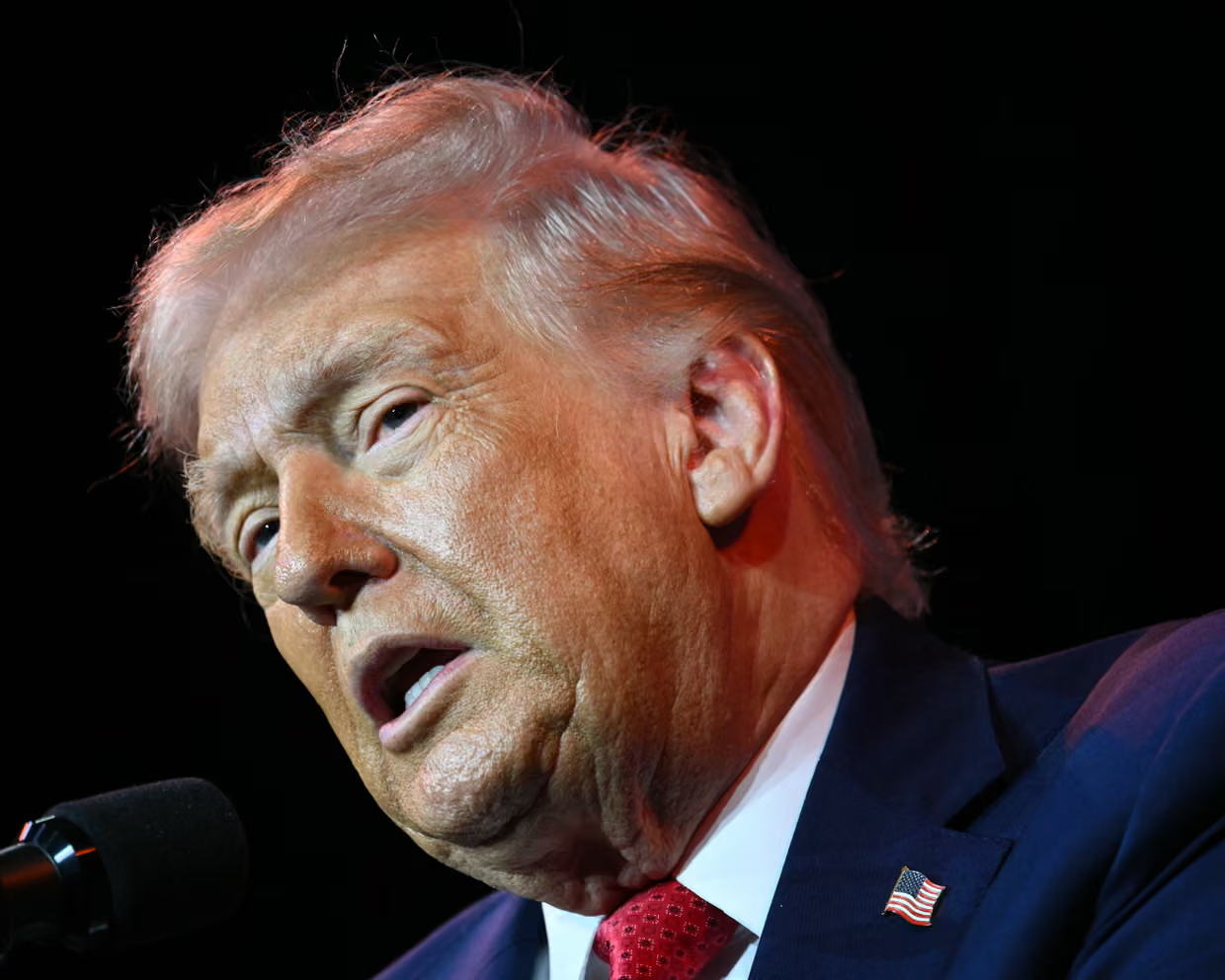
Just one day after President Donald Trump’s claim that Caracas would “turn over” up to 50 million of oil to the US, the U.S. Department of Energy announced on Wednesday (January 7, 2026) that it has begun marketing Venezuelan crude in the global market and that it plans to “indefinitely” control the sales of the South American country’s oil. “We have engaged the world’s leading commodity marketers and key banks to execute and provide financial support for these crude oil and crude products sales,” the Department stated in a fact sheet. On January 3, the U.S. attacked Venezuela and captured its President Nicolas Maduro, who is currently facing narcoterrorism charges in the U.S. a Trump claimed on Tuesday that 30 to 50 million barrels of Venezuelan oil will be brought directly to unloading docks in the U.S. with the help of storage ships and added that he has authorized Energy Secretary Chris Wright to execute the plan. Wright stated that they were "going to market the crude coming out of Venezuela – first this backed up, stored oil, and then indefinitely, going forward, we will sell the production that comes out of Venezuela into the marketplace" during a Goldman Sachs conference in Miami.

Mira Donovan

The move represents a dramatic expansion of U.S. influence over Venezuela’s oil sector, effectively putting the world’s largest proven crude reserves under Washington’s control. It could have wide-ranging consequences for global oil markets, U.S. energy prices and security, and for Venezuela’s battered economy, which has suffered years of sanctions and chronic underinvestment. The shift also underscores a tougher and more interventionist U.S. approach, combining military pressure, selective sanctions relief and direct involvement in oil sales to reshape the future of a major energy producer.

U.S.’s orders to Venezuela

Addressing an interview on Fox News, U.S. Vice-President JD Vance said Venezuela would only be able to sell its oil if it served the interests of the US. “We control the energy resources, and we tell the regime, you’re allowed to sell the oil so long as you serve America’s national interest, you’re not allowed to sell it if you can’t serve America’s national interest,” said Vance. A deal to access to up to $2bn worth of Venezuelan crude was announced by Trump on Tuesday, signifying the response of the Venezuelan government officials to Trump’s demand on opening up to US oil companies or risking more military intervention.

Mr. Wright and the Department of Energy are “working with the Interim Venezuelan Authorities and private industry to execute this deal,” according to the fact sheet. It mentioned that the proceeds from the sale of the Venezuelan crude oil and oil products would initially be kept in accounts controlled by the U.S. before being disbursed “for the benefit of the American people and the Venezuelan people at the discretion of the U.S. government.” “These oil sales begin immediately with the anticipated sale of approximately 30-50 million barrels. They will continue indefinitely,” the Department added. Venezuela, with the world’s largest proven oil reserves is suffocating under tight American sanctions and is currently producing less than 1 million barrels of oil a day. Besides the sanctions, the imposed naval quarantine on Venezuela by the U.S. has hurdled the country’s ability to ship oil out using shadow tankers.

Furthermore, the US energy department has said the “only oil transported in and out of Venezuela” will be through consistent channels approved with US law and national security interests The Trump administration may be able to influence prices by having more control over the world's largest proven crude oil reserves. Despite opposition from Venezuela, Trump has persisted in promising that the U.S. will "run" the nation since the US military captured Nicolás Maduro. Trump also said that Venezuela will purchase “only American made products” with the money the country receives from oils sales by the U.S., on a social media post on Wednesday. “These purchases will include American Agricultural Products, and American Made Medicines, Medical Devices, and Equipment to improve Venezuela’s Electric Grid and Energy Facilities. In other words, Venezuela is committing to doing business with the United States of America as their principal partner – A wise choice,” wrote Trump.

How has Venezuela replied to the U.S.

In a statement, Venezuela's state-run oil company PDVSA said that it is in talks with the United States for the sale of oil "within the framework of the commercial relations" that exist between the two countries. The interim government of Venezuela, headed by former Vice-President Delcy Rodriguez, has sought cooperation with the United States without directly addressing Mr. Trump's claims regarding Caracas sending oil to the United States. Rodríguez has defended plans to open up her country’s oil market to Washington, since Donald Trump’s vice-president JD Vance repeated that the US would have complete control of the country’s supplies. On Wednesday, Rodríguez stated that trade with the US was "not unusual or irregular" and that Venezuela was "open to energy relations where all parties benefit," despite the fact that the US attack to remove her predecessor, Nicolás Maduro, had left a "stain" on their relationship.

In the statement issued in Spanish, which has no reference to Maduro or U.S. sanctions, the company said that “this process is being carried out under schemes similar to those in place with international companies such as Chevron, and is based on a strictly commercial transaction, with criteria of legality, transparency, and mutual benefit for both parties.” The U.S. Department of Energy said Washington is easing some sanctions to let Venezuelan oil reach global markets again, describing the move as a targeted step to allow the “transport and sale of Venezuelan crude and oil products” worldwide. As part of the plan, the department said the U.S. will also approve the import of specialised oilfield equipment into Venezuela to help restart and expand production. Officials said the push will rely on “technology, expertise, and investment from American and other international energy partners” to lift output and update the country’s ageing oil sector.

The U.S. has meanwhile escalated its pressure campaign on Venezuela by capturing two more tankers claiming that it was linked to the country. The European Command of the U.S. said on social media that the vessel Bella 1 was seized in the North Atlantic on grounds of “violations of U.S. sanctions”. The United States had been tracking the tanker for weeks before finally intercepting it, after American officials and media reported that the vessel was being shadowed by Russian naval forces during the pursuit. U.S. Homeland Security Secretary Kristi Noem announced on social media that U.S. forces had also seized the M Sophia in the Caribbean Sea. In her post, she said both ships were “either last docked in Venezuela or enroute to it,” underscoring Washington’s focus on curbing what it sees as illicit oil movements tied to Caracas. The U.S. had captured two other Venezuela-linked ships — the Skipper and the Centuries, last month.

President Donald Trump is set to host top executives from major U.S. oil companies at the White House on Friday in a push to explore how American firms might help boost Venezuela’s struggling oil output. But industry leaders are signalling they won’t rush in without firm assurances from Washington, with U.S. energy firms said to be demanding “serious guarantees” before committing large sums toward projects in Caracas. According to the Financial Times, oil executives plan to press Mr. Trump for robust legal and financial protections to shield their investments before they agree to pour capital into Venezuela’s ageing energy sector. U.S. officials have also told oil company leaders in recent weeks that if they want to play a role in reviving Venezuela’s oil industry, they will need to return quickly and make significant investments to rebuild production — a message that underscores both the opportunity and the risks involved.

What to Watch Next:

  • How global oil markets respond to the release of up to 50 million barrels
  • Caracas’s political response to expanded U.S. control
  • The risk of international backlash
  • Whether continued U.S. tanker seizures and sanctions enforcement heighten tensions with allies and rivals, including Russia
Helen S. Pryor

Editor

Helen S. Pryor covers international news and the environment, bringing a deep commitment to understanding global dynamics and ecological change.

world

U.S. and China Reach Landmark Trade Accord Ending Year-Long Tariff Stalemate

December 01, 2025

world

U.S. to Host First Syrian President Visit Since 1946, Signalling Strategic Shift

December 01, 2025

Member discussion

0 comments

Start the conversation

Become a member of Magazine Gazette to start commenting.