


Subscribe

menu icon

Magazine Gazette | News That Shapes Our World Today

menu icon
×

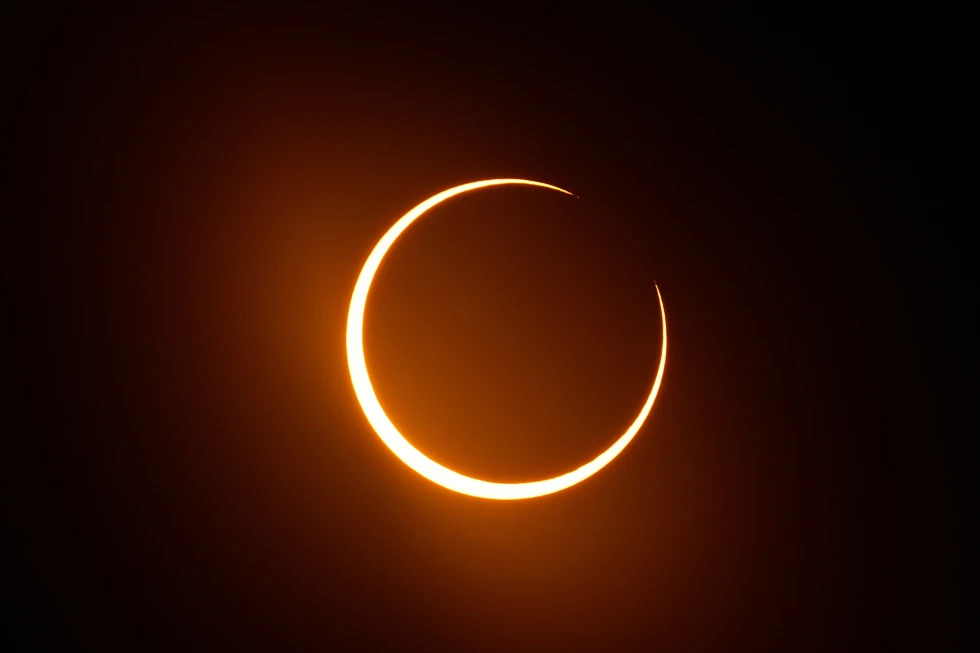
On February 17, 2026, the first solar eclipse of the year will take place¡ªa rare annular solar eclipse. Even while the celestial event has sparked a lot of interest among astronomers and skywatchers, India will not be able to see it because its course mostly passes over Antarctica and portions of the Southern Hemisphere.EarthSky predicts that the eclipse will start at 09:56 UTC and reach its greatest phase at 12:12 UTC. With some visibility in areas near the continent, the event will primarily be visible over Antarctica. The eclipse is predicted to occur in Zimbabwe, Tanzania, and parts of Southern Africa, including Cape Town and Durban. The phenomenon may also be temporarily observed at the southernmost points of Chile and Argentina. Namibia and Mauritius are two more places where the eclipse will be partially visible.

Sam Teague

On February 17, 2026, the first solar eclipse of the year will occur, marking a rare and spectacular annular solar eclipse, often called a ¡°ring of fire.¡± This celestial event has generated significant interest among astronomers, researchers, and skywatchers worldwide. However, the eclipse will not be visible from India because its path is primarily confined to Antarctica and parts of the Southern Hemisphere. According to astronomical predictions, the eclipse will begin at approximately 09:56 UTC and reach its maximum phase at around 12:12 UTC. The annular phase will be visible mainly over Antarctica, where scientists at research stations and the continent¡¯s wildlife, including penguins, will witness the dramatic ring-shaped glow around the sun. Partial visibility is expected in several regions of Southern Africa, including Zimbabwe, Tanzania, Namibia, South Africa, Mauritius, and nearby areas. Additionally, observers in the southernmost regions of Chile and Argentina may briefly witness the partial eclipse. This rare astronomical phenomenon highlights the precise alignment of the Earth, moon, and sun, offering a remarkable reminder of the dynamic nature of our solar system and the importance of continued space observation and research.

  • On February 17, 2026, the first solar eclipse of the year will occur, featuring a rare annular solar eclipse known as the ¡°ring of fire.¡±
  • This astronomical event happens when the moon passes between the Earth and the sun but appears smaller, creating a bright ring of sunlight around the moon.
  • The eclipse will mainly be visible over Antarctica, making it a rare sight mostly witnessed by scientists at research stations and the continent¡¯s wildlife, including penguins.
  • According to astronomical predictions, the eclipse will begin at approximately 09:56 UTC and reach its maximum phase at around 12:12 UTC.

Where will the February 17 solar eclipse be visible?

India falls entirely outside the shadow track of the eclipse, making it impossible to view the event from the country. Although many skywatchers may be disappointed, live streams by agencies such as NASA will provide an opportunity to follow the event online. Visibility of any eclipse depends on geographic location, and this alignment favours the Southern Hemisphere. The next solar eclipse of 2026 is scheduled to take place on August 12.

The eclipse will take place in the Aquarius zodiac sign under the Dhanishtha Nakshatra. At the time of the event, the Sun will be positioned in Aquarius and move into the fourth quarter of Dhanishta. Rahu, Mercury, Venus and the Moon will also align in Aquarius alongside the Sun. Astrologically, the conjunction of Rahu and the Sun in Aquarius is considered to form the eclipse combination, which is traditionally viewed as inauspicious.

Jamie Larson

Senior Writer · Investigative Journalism

Jamie writes deep-dive reporting on technology, society and culture. Former editor at independent publications, Jamie focuses on clear storytelling and long-form investigations.

Technology

Major U.S. Retailer Acquires Logistics Tech Startup

December 01, 2025

Technology

Retail Giant Cuts Over a Thousand Tech Jobs Amid Restructuring

December 01, 2025

Member discussion

0 comments

Start the conversation

Become a member of Magazine Gazette to start commenting.